Water Main to Meter, Meter to House: Who Owns a Georgia Service Line?
A service-line leak can leave a Georgia homeowner wondering whether to call the utility, hire a plumber, or do both. The answer often depends on where the pipe sits in relation to the meter—but the dividing point and responsibility rules can vary by water provider. Here’s how to identify the line, check who handles it, and take sensible next steps.
What a service line is and where the meter fits
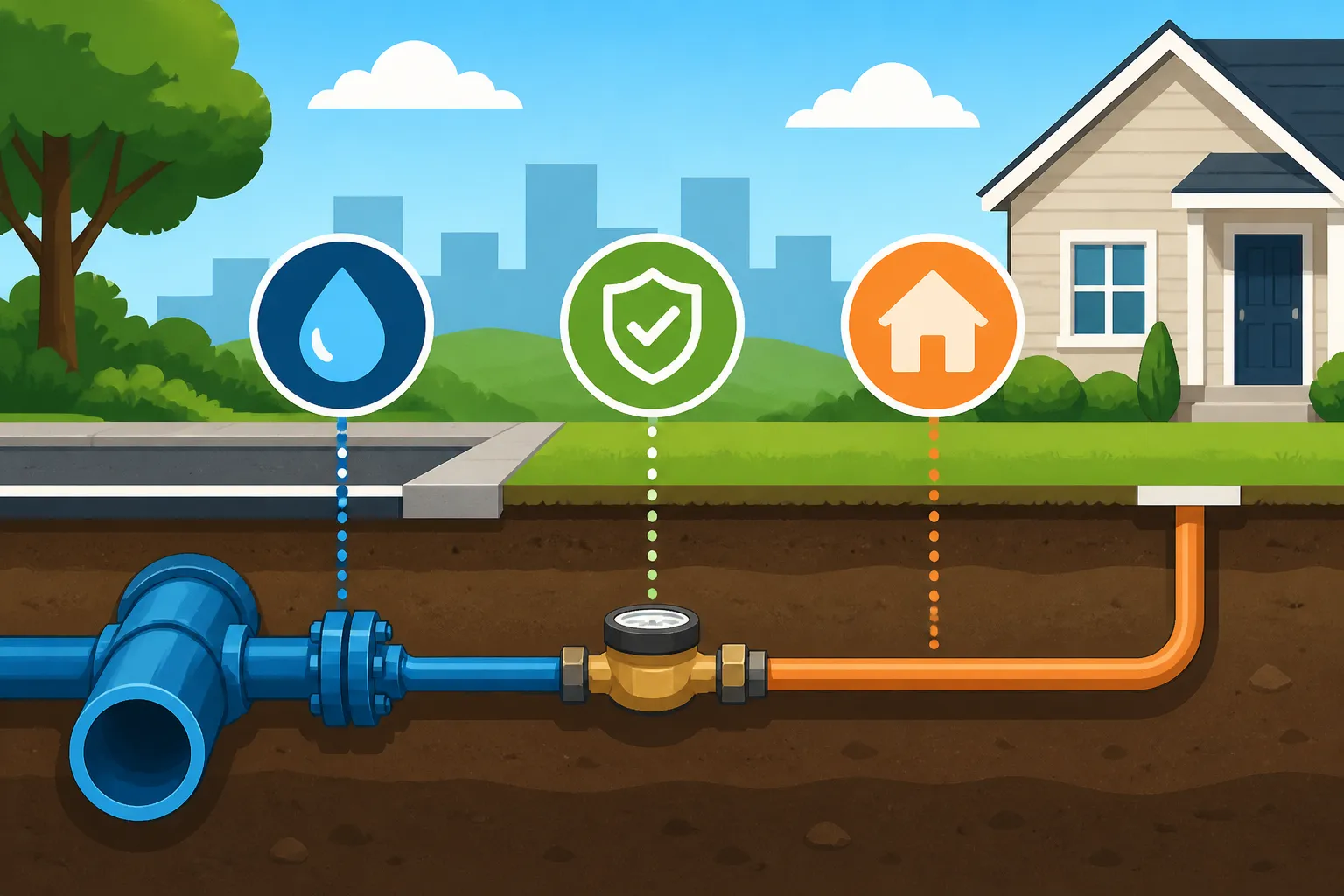
A service line is the pipe that connects a water main in the street or nearby right-of-way to a home or other building. The main carries water through the distribution system; the service line branches off to supply an individual property. The meter measures water use for billing, but it can also serve as a practical reference point for figuring out which portion of the connection the utility maintains and which portion the property owner maintains.
Many utilities describe the connection in two parts:
- The public side runs from the water main to the meter.
- The private side runs from the meter toward the home or building.
That division is common, but it is not a universal Georgia rule that can safely be applied to every address. A provider may use different terms, set a different responsibility boundary, or have rules for equipment and fittings that are not obvious from a simple main-to-meter diagram. Always confirm the policy with the provider serving the property.
The meter is a useful landmark, not a guarantee that every pipe or fitting on one side of it has the same owner. A meter may be in a pit near the street, in a box near a property boundary, or in another location. The actual path of the pipe can be difficult to see, and the service connection may cross land that does not match the assumed division between public and private responsibility.
It also helps to separate three questions that people often treat as one:
- Who owns the pipe? Ownership refers to who holds the property interest in the line.
- Who maintains or repairs it? The provider’s policy may assign maintenance duties to the utility, owner, or both for different parts.
- Who pays for the work? Responsibility for arranging a repair and responsibility for its cost may not be described in exactly the same way. Ask the provider to explain both.
For example, the City of Atlanta Department of Watershed Management says the department is responsible for the service line between the water main and water meter, including the portion from the water main to the water meter, while the property owner is responsible from the meter to the home or building. The City of Roswell says it is responsible for maintaining the public service lateral, which runs from the water main to the water meter, and that the property owner is responsible for maintaining the private service lateral. Fulton County Department of Public Works says the County owns the water service line from the main in the street to the meter, while the property owner owns the line from the meter to the building connection.
| Location or issue | What it may indicate | What to confirm |
|---|---|---|
| Water main to meter | Often described as the public service line or public lateral | Whether the provider owns, maintains, and repairs this section |
| Meter to building | Often described as the private service line or private lateral | Whether the owner is responsible for maintenance and repair |
| Meter, fittings, or meter box | May be treated separately from the pipe on either side | Which parts the provider owns and which parts the owner must protect |
| Leak near the meter | The location may be hard to judge by sight | Whether the provider will inspect and identify the side of the meter |
| Line crossing a shared or neighboring area | The pipe route may not follow the property boundary | Who has access rights and who is responsible for the segment |
If an address falls in one of these areas, the cited provider’s policy is a useful starting point, not a substitute for checking the exact address and current service arrangement. For other Georgia communities, find the provider first; City Water or a Small Community System? Who Serves a Georgia Address can help with that distinction.
How to find the responsibility boundary at your address
Start by identifying the water provider that serves the property. The provider may be a city utility, a county department, or another community water system. A nearby city name or mailing address does not necessarily tell you which organization supplies the tap. If you are moving, buying, or dealing with a property outside a city’s central area, verify service by address rather than relying on a map label or a neighbor’s bill. New Georgia Address? Confirm the Water Supplier Before You Move In explains why that check matters.
Once you know the provider, look for its service-line, meter, leak, or repair policy. Search the provider’s official website or customer documents for terms such as “service line,” “service lateral,” “private lateral,” “meter,” and “leak.” The utility may explain the boundary in a diagram, a frequently asked questions page, a service agreement, or a repair policy. If its wording is unclear, ask for a written explanation that identifies the point where its responsibility ends.
You can use the meter as a first clue while you wait for confirmation, but don’t assume that a visible pipe path proves ownership. Some sections may be buried; the meter may be set away from the building; and a line can run under a driveway, landscaping, or another part of the property. Avoid digging to trace it. A service line can be near other buried utilities, and excavation is not a safe way to settle a question about maintenance responsibility.
When speaking with the provider, have the service address and account information available. Describe where water is appearing, when you first noticed it, whether the meter is accessible, and whether the problem seems to be indoors or outdoors. Ask:
- Where does the provider’s responsibility end for this address?
- Does the provider own, maintain, or repair the line up to the meter?
- Is the meter itself, meter box, or any fitting handled separately?
- Can the provider inspect the suspected leak and identify its location?
- What should the owner do before hiring a contractor?
- Are there rules about excavation, access, or approved repair work?
- If the leak is on the owner’s side, what records or photos should be kept?
- Is there a process to review a bill affected by a leak?
If the provider gives an answer by phone, take notes about the date, the department contacted, and the explanation. If the question concerns a planned sale, a replacement, or a disagreement about responsibility, ask for the policy or boundary in writing. A written response can help prevent different people from interpreting “before the meter” or “at the meter” in different ways.
A service-line map or inventory may provide useful clues about pipe material or the utility’s records, but it may not show every private-side pipe or prove where a leak is. Records can be incomplete, especially on a property where the line has been altered. Treat maps and inventories as starting points, then compare them with the provider’s policy and any available property or plumbing records. For lead-related questions, Got a Service Line Letter From a Georgia Utility? Read This First explains how to interpret a notice without treating it as a tap-water test result.
Who to call when water is leaking
The first task is to report a suspected leak to the water provider, especially if water is surfacing outdoors, the meter appears to be moving when fixtures are off, or the leak may be near the meter or street. The provider can tell you whether the reported location is on its side of the boundary and whether it can inspect. If it believes the leak is on the private side, ask what evidence supports that conclusion and what the owner should do next.
A plumber or other qualified contractor may be appropriate when the leak appears to be in the building’s plumbing or on the private service line. But hiring someone before the provider clarifies its boundary can lead to avoidable expense or work on a section that the utility handles. If the leak is active, ask the provider what immediate steps are appropriate while responsibility is being determined. Avoid opening a meter box or attempting repairs to utility equipment unless the provider specifically directs you to do so.
The visible location of water does not always identify the leak’s source. Water can travel along a trench, pipe, pavement edge, or other path before appearing at the surface. A wet patch near the meter does not by itself prove that the meter or nearby portion of line is leaking. Likewise, water inside a building can come from plumbing downstream of the service line. Tell the provider and contractor what you have observed, but let qualified personnel determine the source.
If the suspected leak is on the property owner’s side, clarify the scope before authorizing work. Ask the contractor to explain where the leak was found, which section needs attention, what work is proposed, and whether the repair requires coordination with the provider. Keep a copy of the written estimate, work description, and any photos or test findings. If the provider needs to inspect before or after the repair, arrange that before the line is covered or the work area is restored.
A leak can also affect a water bill even if the water never reaches a sink or appliance. If the meter records the loss, usage charges may rise. A bill increase is not proof that a service-line leak exists, however: an indoor plumbing leak, irrigation problem, estimated reading, or change in use may also be involved. For a sudden increase, Sudden Spike in a Georgia Water Bill: Leak, Meter Read or Rate Change? offers a way to sort through possible causes. If the leak is beyond the meter and the bill has risen, ask whether the provider has a leak-adjustment policy and what documentation it requires; see How to Ask a Georgia Water Utility for a Leak Adjustment.
For an urgent leak, prioritize contacting the provider and a qualified repair professional as appropriate, rather than waiting to resolve every ownership detail before reporting it. But do not assume that reporting a leak means the provider has agreed to pay for the repair. Keep the questions separate: who will inspect, who will stop the leak, who will arrange the repair, and who may be responsible for the resulting charges.
Repair, replacement, and cost questions
When a line needs repair or replacement, responsibility depends on the provider’s policy and the location of the work. A utility may take care of the public segment while the owner arranges work on the private segment; another local arrangement may use different terms or procedures. Even where the boundary is clear, the work can involve more than the pipe itself: access to the meter, a connection, excavation, pavement, landscaping, or restoration may be handled under separate requirements. Ask the provider to explain what it covers and what it expects the owner to arrange.
Before approving work, ask for the proposed repair location and scope in writing. A useful description identifies whether the work is on the public side, private side, or at a connection the provider treats separately. If the contractor’s assessment and the provider’s position do not match, request an inspection or explanation before authorizing disputed work, when it is practical and safe to do so.
Do not assume that replacing a visible portion of pipe will resolve every concern about the service line. A line can include different materials or connections along its route, and a repair may address only the section that failed. If the concern involves lead or another material of interest, ask which sections were inspected and what records exist for the rest of the line. An inventory entry is a record classification, not a laboratory result from the water at a home’s tap. An Unknown Service Line Is Not the Same as a Positive Lead Test explains that distinction.
If lead is a concern, a service-line repair and a drinking-water sample answer different questions. Pipe material records can help identify potential sources, while a tap sample measures what was present in the sampled water under the sampling conditions. For a specific lead concern, ask the water provider about any inspection or sampling options and consult a qualified professional about the appropriate next steps. Getting a Reliable Lead Test of Home Tap Water in Georgia describes why sampling details matter.
Ask whether the proposed work requires provider approval, a permit, a particular contractor qualification, or coordination with a utility crew. Requirements can vary by location and by the part of the system involved. Do not rely on a general contractor’s assumption that a private-side repair can proceed without checking local requirements. The provider can direct you to the official requirements and current contact information.
The price of service-line work depends on the location and scope, so a general estimate may not be useful for a particular property. For a private-side repair, request a written estimate that identifies the work included, any likely restoration, and what might change the scope. For a provider-managed repair, ask what costs, if any, the owner may still face and whether the provider’s responsibility includes related restoration. Check the provider’s current policy rather than assuming that ownership automatically means every associated cost is covered.
After work is complete, keep the invoice, contractor’s description, photos, provider correspondence, and any inspection or test records. These may be helpful if the same area leaks again, if a future owner asks about the line, or if the bill is disputed. If the repair was made near the meter, ask the provider to confirm the work did not affect the meter or its reading. If the water use remains unusually high, continue investigating rather than assuming the service-line work solved the billing issue.
Rentals, shared lines, and property sales
The owner-responsibility boundary can be confusing for tenants. A renter may see water pooling in a yard or receive a bill that has increased, but may not know where the service line runs or whether the meter is shared. Report the problem promptly to the landlord or property manager and, where appropriate, to the water provider. Give a clear description and keep a record of the report. The provider can explain its own service-line boundary, while the lease and landlord-tenant arrangements may determine who coordinates private-side work. Landlord or Utility? Who Georgia Renters Call About Bad Tap Water is useful when the problem is water quality rather than a visible leak; for a billing issue, One Water Meter, Two Units: How Shared Meters Work in Georgia Rentals covers shared-meter questions.
A shared meter or service line can make it harder to connect a leak to one unit. Ask the landlord or property manager who receives the utility bill, whether the line serves multiple units, and how a repair would be coordinated. Do not assume that a tenant can authorize excavation or work on a shared pipe. If a leak appears to be causing damage or a high bill, document what is visible and notify the responsible parties without delay.
For a home purchase, service-line questions are best raised before closing rather than after a leak or material concern appears. Ask the seller for available utility notices, repair invoices, service-line records, and any provider correspondence. Confirm which provider serves the address and request its current division of responsibility. If the line’s material or route is unknown, ask what inspection or records review is available; do not treat the absence of a notice or a map entry as proof that the line is a particular material. Buying a Georgia Home With an Unknown Service Line: Questions to Ask provides a more specific due-diligence checklist.
A property boundary and a service-line responsibility boundary are not necessarily identical. A line may cross a driveway or run through an area with access arrangements that are not obvious to a buyer. If a repair may require work beyond the property or access through another area, ask the provider and the relevant property professionals how access will be handled. Avoid making assumptions based solely on the location of the meter or the street.
For a seller, gather records before a buyer asks. Useful documents can include the provider’s service-line notice, any material identification, invoices for repairs, contractor notes, and written explanations of who maintains each part. If information is incomplete, describe what is known and what remains unknown rather than presenting a guess as a verified fact. A buyer can then follow up with the provider and decide whether additional inspection or testing is appropriate.
A practical checklist for resolving a service-line question
Use this sequence to move from uncertainty to a clear next step:
- Identify the provider. Confirm which water system serves the exact address. Do not infer it from a mailing address, city limit, or nearby property.
- Describe the problem. Note where water is visible, whether the meter is accessible, and whether the issue is continuous or intermittent. Avoid digging or opening utility equipment.
- Contact the provider. Report the suspected leak or ask about the responsibility boundary. Request the answer in writing if the location or cost is disputed.
- Confirm the boundary and the parts involved. Ask about the main-to-meter section, the meter itself, and the meter-to-building section separately.
- Arrange inspection before work where possible. If the provider needs to inspect or approve work, coordinate before a contractor covers or alters the suspected area.
- Hire an appropriate professional for private-side work. Ask for a clear scope, written estimate, and any required coordination with the provider.
- Keep records. Save correspondence, photos, invoices, inspection notes, and relevant bills.
- Follow up on billing or material concerns. A repair, a bill review, a service-line inventory, and a tap-water test answer different questions. Request the relevant process for each.
This checklist is a way to organize the conversation, not a substitute for the provider’s policy. If the provider and contractor disagree about where the leak is, pause before authorizing disputed work if circumstances allow, and ask what inspection can resolve the disagreement. For a bill problem, use the utility’s billing review process separately from the repair discussion. Steps for Disputing a High Water Bill in Georgia Before You Pay covers the billing side.
The central takeaway is simple: use the meter as a starting point, not as your only evidence. Confirm the provider, get its specific boundary in writing, and separate ownership from maintenance, repair, and cost. That approach helps avoid misdirected calls and unnecessary work while preserving a clear record of what was found and who agreed to handle it.
Frequently Asked Questions
Is the homeowner always responsible for the pipe after the meter?
Not necessarily under a single statewide rule that can be assumed for every address. Providers may describe the boundary differently. Check the policy of the utility serving the property and ask it to confirm who maintains and repairs the private-side line.
Does the water meter mark the exact ownership boundary?
It may be the provider’s stated reference point, but the meter and related equipment can be treated separately from the pipe. Ask the provider how its policy applies to the meter, fittings, and the specific line at the address.
Should I call a plumber or the water provider first?
If the leak may be near the meter, street, or outdoor service line, contact the provider first to report it and clarify its responsibility. A plumber may be needed for a building-side or private-side problem. Ask the provider what inspection or coordination is required before work begins.
Does a service-line map prove what material is on my property?
A map or inventory can provide useful records, but it may not document every section or establish the material of every pipe. Ask the provider what its records cover and what inspection or testing is appropriate for a specific concern.
Can a service-line leak explain a higher water bill?
It can, if the meter records the water loss, but a higher bill can have other causes too. Ask the provider about the meter reading and its leak-adjustment process, and investigate the property for other possible sources of increased use.
Sources
- City of Atlanta Department of Watershed Management — Service Line Information | We are here to serve you (checked November 13, 2026)
- City of Roswell — Lead & Copper – Environmental Public Works (checked November 13, 2026)
- Fulton County Department of Public Works — Lead & Copper (checked November 13, 2026)
Disclaimer
This article is for general informational purposes only and does not constitute professional advice. Laws, prices and regulations vary by location and change over time. Consult a qualified professional for guidance on your specific situation. Georgia Water Guide is not a government agency or water utility and is not affiliated with any public water system.