Steps for Disputing a High Water Bill in Georgia Before You Pay
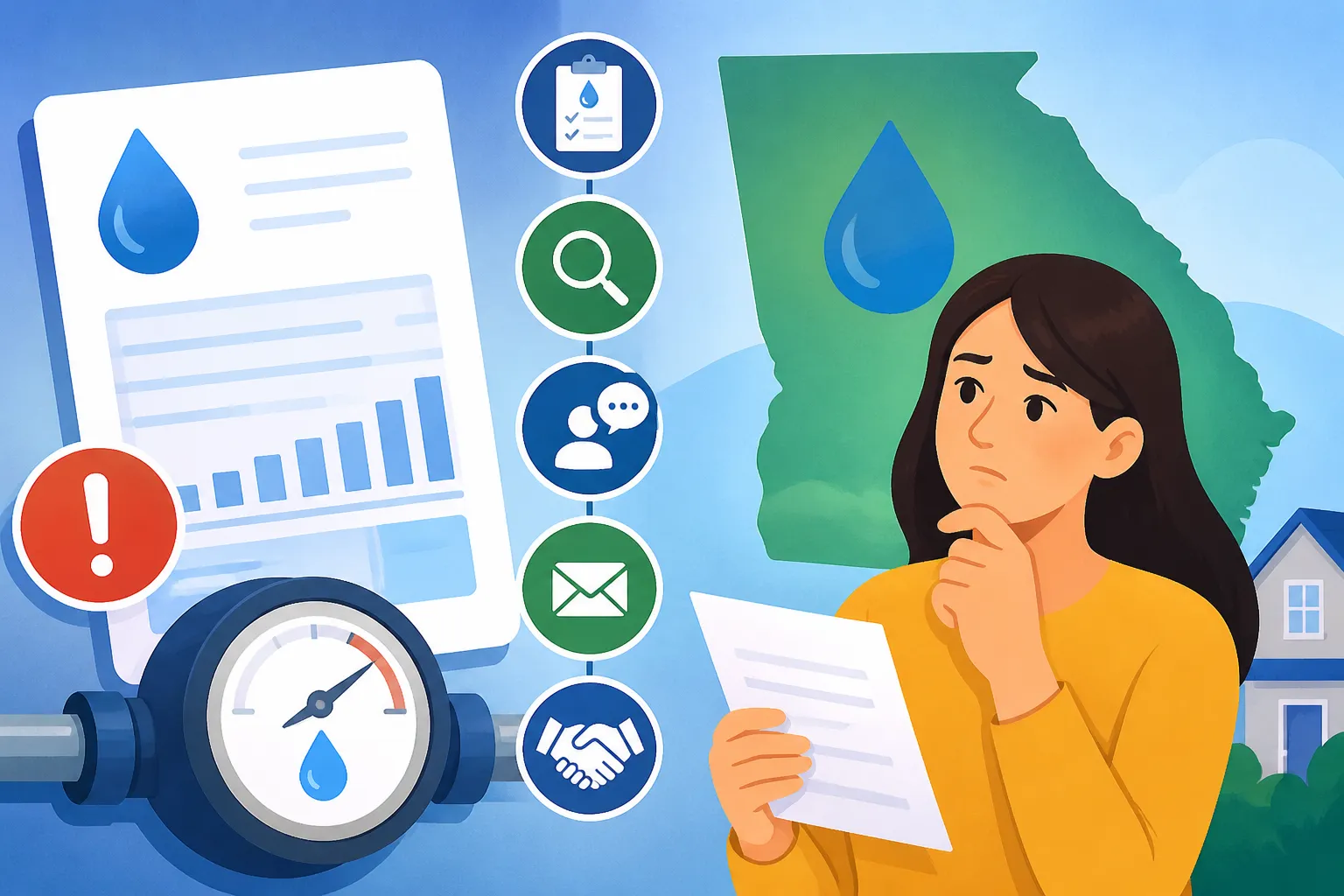
A water bill that suddenly jumps can be alarming, especially when the due date is close and the cause is unclear. In Georgia, billing rules and review procedures depend on the utility serving your address. These steps help you check the bill, preserve evidence, request a review before paying, and avoid letting a dispute turn into a service problem.
Protect your account while you investigate
Start with the due date and the amount the utility says is currently owed. A billing dispute does not automatically pause late charges, collection activity, or service-disconnection procedures. Ask the utility what happens to your account while it investigates and whether it can place the disputed portion on hold. Get the answer in writing if possible.
That does not mean you must accept a bill you believe is wrong. It means you should separate two questions:
- Is the bill accurate? The utility can review the reading, billing period, rate calculation, meter history, and account details.
- What should you do while it is being reviewed? The utility’s rules may allow a payment arrangement, a partial payment, or a temporary hold on the disputed amount. The options are not the same everywhere.
If you can pay the amount you consider undisputed, ask whether doing so affects your right to challenge the rest. Do not assume a partial payment will prevent a late fee or shutoff. Ask how payments are applied, whether the account must remain current during review, and what deadline applies to any appeal.
Keep a record from the beginning. Write down the date and time of each call, the name or identifier of the representative if provided, what was discussed, and any next steps. Save bills, notices, payment confirmations, emails, screenshots, and photos in one folder. If the utility gives you a case or reference number, include it in later messages.
Make the first contact promptly
Use the contact method listed on the bill or the utility’s official website. If the bill is near its due date, contact the utility right away rather than waiting until you have finished every possible home check. You can say that you are disputing the bill, explain what looks wrong, and ask how to prevent the account from being treated as delinquent while the review is pending.
Ask these questions:
- What is the deadline to dispute this bill?
- What amount is due while the review is pending?
- Can the disputed amount be placed on hold?
- Will late charges or collection activity continue during the review?
- What evidence does the utility need?
- How will the utility tell you the result, and how can you appeal it?
The answers may depend on local ordinances, the utility’s customer rules, and the type of provider. Save a copy of any policy the utility points you to. If the representative cannot answer a question, ask for the billing supervisor or the department that handles adjustments and formal appeals.
Don’t wait for a shutoff notice
A high bill is easier to address before it becomes a past-due balance. If you have already received a warning, say so when you contact the utility and ask specifically whether a billing review changes the payment deadline or disconnection process. Get clear instructions rather than relying on a general assurance that “the account is under review.”
If you cannot pay the full bill while it is being checked, ask about payment arrangements and whether an arrangement will keep service active. The utility’s rules may distinguish between the disputed bill and older unpaid charges. If the issue is a hardship as well as a billing error, ask what assistance or payment options are available. The article Where Georgia Customers Can Look for Water Bill Assistance offers a separate starting point for finding help.
Check the bill before blaming the meter
A high bill can result from a wrong reading, a billing adjustment, a changed rate, a leak, or unusually high use. Start by comparing the current bill with several earlier bills. Look at the billed water volume, reading dates, meter-reading type, and each charge—not just the total amount due.
The line items matter because a water bill may include more than water use. Depending on the provider, it may show a base charge, water usage, sewer service, stormwater charges, or other local fees. Some charges may be fixed, while others may change with usage or a rate schedule. The article Reading the Water, Sewer and Other Line Items on a Georgia Bill explains how to sort those parts out.
| What to check | What it may reveal | What to ask the utility |
|---|---|---|
| Billing period | A longer-than-usual cycle can raise the total without a sudden daily-use increase | Were the start and end dates different from the usual cycle? |
| Current and previous readings | A reading typo, rollover, or correction may be possible | Was this an actual reading, an estimate, or an adjusted reading? |
| Meter-reading method | An estimated bill may be followed by a catch-up bill | Which readings were estimated, and when was the meter last read in person? |
| Usage units | A unit conversion or display mismatch can confuse comparisons | What unit does the bill use, and how does it correspond to the meter? |
| Rate and charge lines | A rate or billing classification change may explain part of the increase | Which rate schedule and account classification were applied? |
| Sewer calculation | Sewer charges may be based on water use or a local method | How was the sewer amount calculated for this billing period? |
| Account details | A wrong address, meter, or account association can lead to an incorrect bill | Is this meter assigned to the correct service address and account? |
Compare usage, not just dollars
A higher dollar total does not always mean the household used more water. The bill may cover more days, include a rate change, or contain a prior adjustment. Compare the volume billed and the number of days in each cycle. If the bill lists average daily use, compare that figure too.
If the current bill shows much higher use than usual, calculate the change in volume against the previous cycle and the same season if you have those records. A household may use more water during a dry stretch because of outdoor watering, guests, filling a pool, or other seasonal activity. But if the increase is far beyond what those activities could explain, note that in your dispute.
The detailed steps in Base Charge vs. Usage: How a Georgia City Water Bill Is Calculated can help you determine whether the increase is tied to consumption or to a charge that applies regardless of use.
Check whether a reading was estimated
Look for words such as “estimated,” “actual,” “read,” or a similar notation. The terms differ among providers. If the utility estimated one or more earlier bills, the current charge may reflect a catch-up after an actual reading. Ask for the readings used for each billing period and the dates they were recorded.
Compare those readings with the numbers on the meter if you can safely access it. Do not open a locked meter box or interfere with utility equipment. Take a clear photo of the meter display, including any visible meter identification, and record the date. If the displayed reading is lower than the reading printed on the bill, first check that you are looking at the meter assigned to your account and that you understand how the display is read. Then send the photo to the utility and ask it to verify the account and reading.
An estimated bill followed by a much larger bill can be frustrating, but it does not by itself prove the current reading is wrong. How a Catch-Up Bill Gets So Large After Estimated Georgia Readings explains what to check when an actual reading replaces estimated ones.
Review rates and account changes
Ask whether the rate schedule, service classification, or billing method changed during the period. A utility may apply different charges to different customer types or usage levels. The utility should be able to tell you which schedule applies to your account and when it took effect. Do not assume a neighbor’s bill is an accurate comparison if the neighbor has a different meter, service area, rate class, or billing period.
Also review recent changes to the property or account. A new irrigation connection, an added dwelling unit, a change in occupancy, or a meter replacement can affect how use is measured or billed. If you recently moved, check the account start date and whether any earlier balance or adjustment appears on your bill. Ask the utility to identify each charge you do not recognize.
Look for leaks and changes at home
If the billed usage is high and the reading appears plausible, check whether water is flowing somewhere on the property. A leak can run for days without being obvious, especially if it is in a toilet, an irrigation line, a crawl space, or a buried service line.
Start with a simple meter check. Turn off faucets and water-using appliances, and make sure no one is using water during the check. If it is practical, pause automatic irrigation and other scheduled uses. Note the meter reading, wait for a period with no intentional water use, and check again. A changing reading can indicate water is passing through the meter, but it does not identify where the water is going. Follow the meter instructions provided by the utility and do not handle equipment that is locked or marked as utility property.
A stationary reading does not rule out every intermittent leak. Some leaks occur only when an appliance runs, a toilet refills, or an irrigation system cycles. If the first check is inconclusive, repeat it at a time when those systems are not operating.
Check common indoor sources
Toilets are a frequent source of unnoticed water loss. Listen for a toilet that refills when no one has used it, look for water moving in the bowl, or use a dye test if the toilet manufacturer’s instructions allow it. A simple dye test can show whether water is passing from the tank into the bowl without a flush. The steps in Water Bill Doubled Overnight? A Toilet Dye Test and Other Home Checks can help you investigate likely household sources.
Also look for:
- Dripping faucets or showerheads
- A running or leaking water heater
- Damp areas near plumbing, appliances, or the foundation
- Water sounds in walls when no fixture is in use
- A refrigerator or ice maker with a leaking supply line
- An appliance that fills or drains repeatedly
- A crawl space or basement area that is unexpectedly damp
Do not try to repair a pipe or appliance if doing so could cause damage or create a safety risk. A licensed plumber can inspect the home’s plumbing when the source is not clear.
Check outdoor and less visible use
Outdoor water use can be easy to overlook. Check irrigation schedules, broken sprinkler heads, hose connections, outdoor faucets, pool autofill devices, and water features. A damaged irrigation valve can continue to use water even when a controller appears to be off. If you have recently planted grass, washed a vehicle, filled a pool, or hosted visitors, record those details. They may explain some of the increase, even if they do not explain all of it.
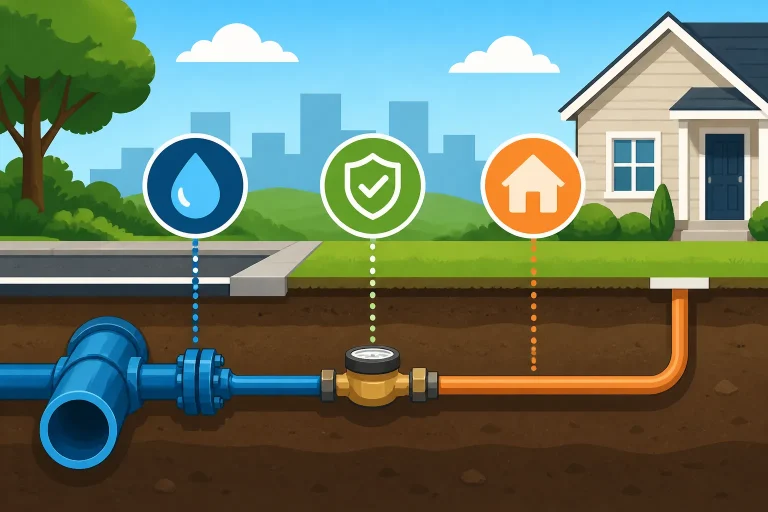
If the meter continues to move after all household use is shut off, the leak may be on the customer’s side of the service line or within the property. The responsibility boundary varies. In Georgia, a meter is often a useful reference point, but the exact division of ownership and repair responsibility depends on the utility’s rules and the property arrangement. See Water Main to Meter, Meter to House: Who Owns a Georgia Service Line? before assuming the utility or homeowner is responsible.
A leak beyond the meter can raise the bill even when the customer did not know it was happening. Do not assume the utility will automatically remove the extra usage from the bill. Ask whether it offers a leak adjustment, what conditions apply, what proof is needed, and whether repairs must be completed by a particular deadline. Keep invoices, photos, and repair notes. A Leak Past the Meter: Who Pays the Georgia Water Bill It Runs Up? covers the responsibility question in more detail.
Consider recent changes in household use
Make a short timeline covering the billing period. Note changes such as:
- More people staying in the home
- A tenant moving in or out
- More laundry or bathing than usual
- A malfunctioning appliance
- A new irrigation routine
- A pool being filled or topped up
- Work on plumbing, the meter, or the service line
- A period when the property was vacant
This timeline can help you and the utility distinguish an unexpected reading from a real increase in use. It may also show that the billed cycle included a period of unusual use that is no longer continuing.
Gather evidence and request a formal review
Once you have checked the bill and looked for likely sources of high use, send the utility a concise written dispute. Use the channel it specifies for billing complaints, and keep a copy of everything you submit. If the utility accepts disputes only through a particular form or portal, follow that process and save a confirmation.
A useful dispute does not need to prove the cause before the utility begins reviewing the account. It should identify the bill, state what appears wrong, describe what you have checked, and ask for specific actions.
Include:
- Your service address and account number
- The billing period and amount in dispute
- The billed usage and the usage shown on earlier bills
- Whether the reading was marked actual or estimated
- Photos of the meter and its identification, if relevant
- Notes about any meter check or leak inspection
- Repair records or a plumber’s findings, if available
- The resolution you are requesting, such as a reading review, meter test, account correction, or explanation of a charge
Avoid sending more personal information than the utility needs. Use its official website or another verified channel rather than replying to an unexpected message that asks for account details.
Ask for the review you need
Be specific. “Please check my bill” is a reasonable start, but it may leave important questions unanswered. Depending on the issue, request that the utility:
- Verify the meter is assigned to the correct address and account.
- Review the dates and readings used to calculate the bill.
- Confirm whether each reading was actual or estimated.
- Explain any correction, adjustment, or rate change.
- Review the meter’s operation if the reading still appears inconsistent.
- Explain how sewer and other usage-based charges were calculated.
- Tell you whether a leak adjustment is available and what documentation it requires.
- Explain payment obligations and service protections while the review is pending.
If you request a meter test, ask how the test is performed, whether you need to be present, whether the test result will be provided in writing, and whether any charge applies if the meter is found to be operating within the utility’s standards. Do not assume a meter test is free or that the outcome automatically cancels the bill. The utility’s policy should state how it handles test results and any related adjustment.
A meter may register water correctly even when a leak is responsible for the high usage. Conversely, a meter or reading problem may be possible even when no leak is found. The point of a review is to check evidence, not to assume one explanation in advance.
Keep the request focused and factual
A clear timeline is more useful than a long account of every frustration with the utility. Explain the issue in order: the usual usage, the unusual bill, what the bill says about its reading, what you checked at home, and what you want reviewed.
For example, a dispute could state that the bill shows an unusually high volume compared with recent cycles, the reading appears to be actual, no intentional increase in outdoor use occurred, and the meter reading has been photographed. Then ask the utility to verify the reading and meter assignment and explain the next step for a meter review.
If you found a leak and repaired it, say where it was, when it was repaired, and what records you have. If you did not find a leak, say what you checked without claiming that this proves there was none. A careful description makes it easier for the utility to evaluate the request.
Track the response and deadlines
Ask when the utility expects to respond and how it will deliver the decision. If you do not receive an answer by the stated time, follow up using the same case number and attach the original request. Keep copies of any revised bill, adjustment, test report, or written explanation.
If the utility denies the request, ask for the reasons in writing and the steps and deadline for appealing. Read the decision closely. It may address only one part of the bill—for example, the meter reading but not a sewer calculation or a leak adjustment. If the utility approved an adjustment, verify how it was applied and whether a remaining balance is still due.
Escalate if the utility does not resolve it
The next step depends on who provides water to your address and how that provider is regulated. Georgia has many city, county, regional, and other water providers, so there is no single billing appeal route that applies to every customer. First identify the provider and its formal complaint procedure. The article City Water or a Small Community System? Who Serves a Georgia Address can help with the provider question if you are unsure who bills the property.
If the provider is a city or county utility, ask what local administrative appeal is available. That may involve a billing supervisor, a customer-service review, a utility department manager, or another process set by the local government. Follow the appeal instructions in the utility’s written decision and keep evidence that you submitted the appeal on time.
If the provider is privately owned, check whether the Georgia Public Service Commission has authority over that specific provider and type of service. Do not assume that every water provider is under the same regulator. The provider’s bill or official website may identify its regulator and complaint procedure. If the provider’s status is unclear, use official agency websites to verify which office handles the matter.
The Georgia Environmental Protection Division has a role in drinking-water regulation, but a disagreement about a customer’s bill is generally a billing matter for the utility and the applicable local or regulatory process. A drinking-water quality complaint and a high-bill dispute are not the same issue. If you are also concerned about water quality, handle that concern separately through the relevant utility or public-health channels.
Write a short escalation summary
When you move the complaint to a higher level, send a brief summary rather than starting over. Include:
- The date you first contacted the utility
- The case number, if one was provided
- The bill and billing period at issue
- The evidence you submitted
- The utility’s response or lack of response
- The specific decision or action you are asking for
- Any deadline or shutoff notice that makes the matter urgent
Attach the original bill, your dispute, and the utility’s response. Avoid sending original documents unless requested. If you speak with someone by phone, follow up with a short written message confirming what you understood.
If the matter remains unresolved, ask the utility to identify the final level of its internal review and the outside office, if any, that can review the complaint. An outside complaint may not pause payment deadlines or service actions, so ask separately about the account while the complaint is being considered.
Know when professional advice may help
If the dispute involves a large balance, a shutoff threat, a property sale, a landlord-tenant disagreement, or a complicated shared-meter arrangement, consider getting advice from a qualified professional or a local legal-aid organization. The right option depends on the facts and location. This is especially important if a utility’s written decision gives a short appeal deadline or if the disputed amount includes charges from before you occupied the property.
If you rent or share a meter
Renters should first determine who holds the utility account. If the account is in the landlord’s name, the utility may discuss account details only with the account holder or an authorized person. Ask the landlord to request a review and share the bill, readings, and utility response. Keep your own written record of the request and any amount you are asked to pay.
If the account is in your name, contact the utility directly and follow the same dispute steps as any other customer. Tell the landlord if the issue may involve plumbing or an appliance in the building. A leak in shared plumbing can affect the bill even if the tenant did not use the water intentionally.
Do not assume a lease, rent statement, or landlord calculation explains how the utility bill was produced. Ask for the original bill and any calculation used to divide charges. Local rules, lease terms, and the specific account setup matter. Landlord or Utility? Who Georgia Renters Call About Bad Tap Water addresses water-quality responsibility; for a billing issue, the account holder and lease terms are central.
Shared meters need a different paper trail
A single meter may serve more than one unit, such as a duplex or a small multi-unit building. In that situation, the utility’s reading may accurately measure the property’s total use while providing no separate measurement for each household. A high total bill does not establish which unit used the water or whether a leak occurred in shared plumbing.
Ask the property owner or manager for:
- A copy of the original utility bill
- The method used to divide the charge
- The number of units included in the calculation
- Any separate submeters and their readings
- Information about common areas or shared outdoor fixtures
- Details of repairs or leak checks during the billing period
If a submeter is used, ask when it was read, whether the readings were recorded, and how the allocation relates to the utility bill. If the property has no separate meters, request the written method used to divide the charge. Do not treat an estimated household share as a direct meter reading.
The articles One Water Meter, Two Units: How Shared Meters Work in Georgia Rentals and Splitting a Water Bill on a Shared Meter in a Georgia Duplex explain the practical limits of shared-meter billing and what records to request.
Separate a utility dispute from a disagreement over who pays
The utility can review the account it bills, but it may not decide how a landlord and tenant must divide a charge under a lease. If the landlord passes through a water bill, ask for the original bill and a written calculation. If you believe the charge conflicts with your lease or local requirements, seek location-specific tenant advice rather than relying on the utility to resolve that dispute.
A shared meter also makes it important to document repairs and access. Ask the property manager to check common-area toilets, irrigation equipment, and plumbing that serves multiple units. If a leak is suspected, note when it was reported and what action followed. This record can help clarify whether the high usage continued after the problem was addressed.
Frequently Asked Questions
Should I pay a high water bill while disputing it?
Ask the utility what amount is due during the review and whether it can hold the disputed portion. A dispute does not automatically stop late charges or service procedures. If you can pay an undisputed amount, ask how that payment will be applied and whether it affects your appeal.
Can I ask the utility to test my meter?
Yes, you can ask whether the utility offers a meter test and how to request one. Before proceeding, ask how the test works, whether a charge may apply, how you will receive the result, and what happens if the meter is found accurate. A correct meter can still measure water lost through a leak.
Will a leak adjustment erase the whole bill?
Not necessarily. Adjustment policies vary, and an approved credit may cover only part of the increased usage or require specific proof. Ask about eligibility, repair documentation, deadlines, and how the adjustment is calculated. Keep repair records and photos.
Who handles a Georgia water-bill complaint?
Start with the utility that issued the bill and follow its written review process. The outside escalation route depends on whether the provider is a local government utility or a provider subject to another regulator. Confirm the provider’s status and complaint procedure through official sources.
What if the high bill is for a rental with a shared meter?
Request the original utility bill and the written method used to divide the charge. Ask whether separate submeters exist and whether common plumbing, irrigation, or a leak could affect the total. The utility may be able to review the property’s total usage, while the landlord-tenant allocation may be a separate issue.
Disclaimer
This article is for general informational purposes only and does not constitute professional advice. Laws, prices and regulations vary by location and change over time. Consult a qualified professional for guidance on your specific situation. Georgia Water Guide is not a government agency or water utility and is not affiliated with any public water system.